
Memphis Commercial Concrete Contractors & Megasite Flatwork
Turnkey multi-million sq ft distribution slabs, heavy freight aprons, and tilt-up logistics construction.
Specialty: Megasite Logistics Warehouses, Heavy Dolly Strips & Tilt-Ups
Request a Commercial Bid Review
Commercial Concrete Contractors in Memphis: Quick Answer
Commercial concrete contractors in Memphis, Tennessee build the slabs, foundations and structural pours behind megasite logistics warehouses, heavy dolly strips & tilt-ups. Success depends on ground conditions (mississippi river delta silt mitigation, new madrid seismic considerations), a mix and reinforcement package matched to the load, and floor-flatness control that meets the owner's equipment. Typical specifications in this market are listed below and are confirmed project by project with the engineer of record.
Memphis Commercial Concrete Services
Megasite Distribution Center Slabs
Large-scale continuous laser-screed pours for international freight and e-commerce distribution hubs.
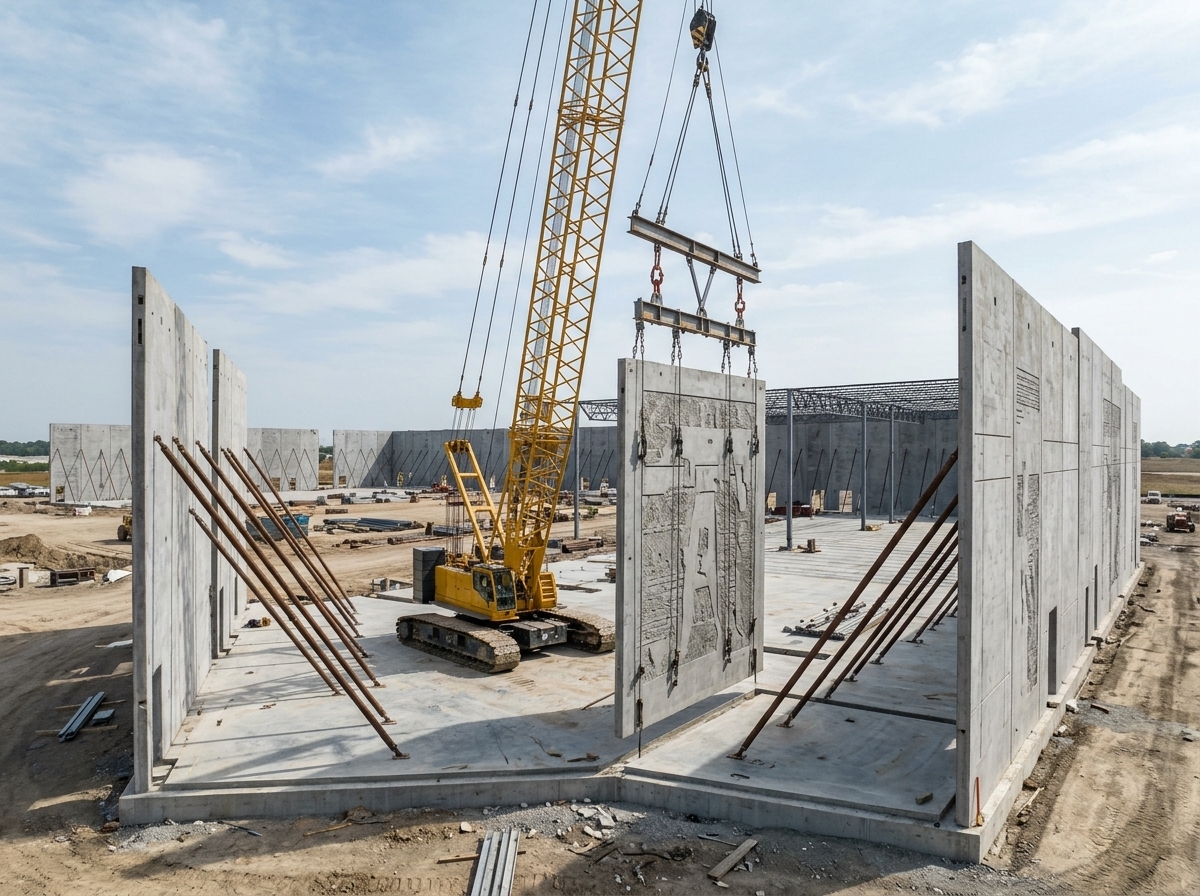
Commercial Tilt-Up Walls
High-speed tilt-up wall panel forming, casting, and crane rigging for industrial flex space.
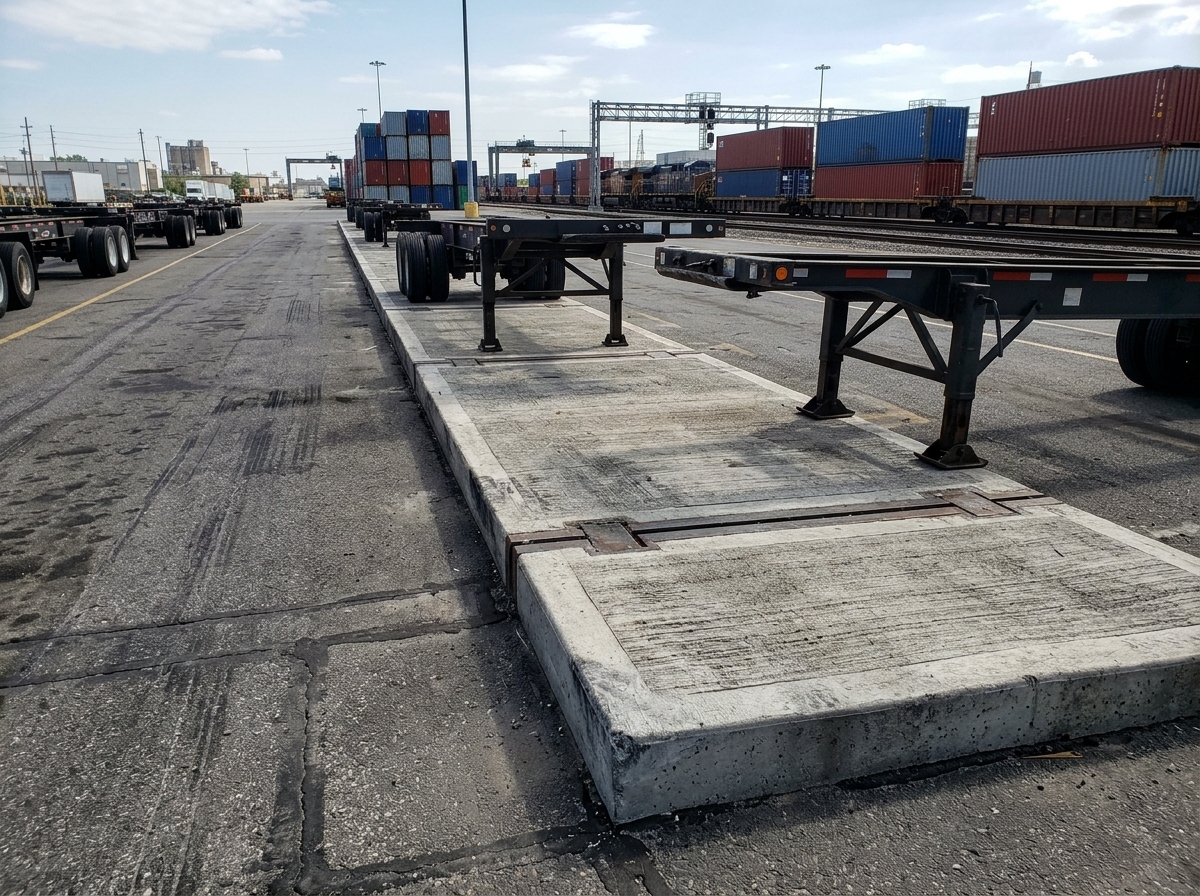
Intermodal Dolly Strips & Aprons
Reinforced 10" thick concrete pads engineered to handle heavy dropped intermodal chassis.
Heavy Concrete Core Drilling & Trenches
Deep core drilling for high-voltage industrial gear and drainage slab trenches.
Memphis Concrete Specifications at a Glance
Reference specifications for Memphis commercial work. Final mix designs, tolerances and reinforcement are set by the project engineer and specifications.
- Concrete mix standard
- 4,000–5,500 PSI mix with high-performance water reducers
- Floor flatness (FF / FL)
- FF 50 / FL 40 for narrow-aisle high-density warehouse racking
- Reinforcement
- Grade 60 structural rebar grids and continuous synthetic macro-fibers
- Ground conditions we design around
- Mississippi River Delta silt mitigation, New Madrid seismic considerations
Commercial Concrete Scopes We Build in Memphis
Illustrative renderings of the scope types, not photographs of completed projects.

Industrial Corridors We Serve
The Commercial Concrete Guide for Memphis Logistics Owners, GCs and Developers
Memphis is a freight town before it is anything else. Five Class I railroads reach the metro, the Mississippi River carries barge traffic past the Port of Memphis, interstates converge on the city, and the FedEx World Hub sits on airport property that is leased on a scale few cities can match. That combination explains why so much of the concrete poured here is horizontal: warehouse floors measured in the hundreds of thousands or millions of square feet, truck courts, trailer parking, and heavy container-handling pavement. If you own, develop or build in this market, the slab is usually the largest single structural scope on the job.
The Memphis industrial inventory is enormous and spread across several submarkets. Published broker data describes the Southeast submarket as the largest in the metro, and activity also spills across the state line into DeSoto County, Mississippi, and out to the newer megasite-era locations east of the city. Most modern big-box product in the region is tilt-wall with a slab-on-ground, which means the same concrete crew often has to think about the floor as a casting bed, a structural diaphragm and a finished warehouse surface at once. Speed matters, but so does the long-term performance of joints under forklift and reach-truck traffic.
A specialty commercial concrete contractor earns its place on these projects in the details that generalist crews underestimate. Subgrade in Memphis is rarely uniform: silty loess uplands, softer river alluvium to the west, and a seasonal wet-weather window that can turn a graded pad into a mud bath within a day. Summers are hot and humid, so a morning placement can run into a plastic-shrinkage or finishing-timing problem by noon. And owners who plan for narrow-aisle racking, automated storage or high-throughput cross-dock operations often specify flatness and levelness targets that leave very little room for a slow finishing crew.
This guide is written for owners, general contractors and developers who need a straight picture of what drives concrete scope, cost and schedule in Memphis. It covers the local soils and seismic backdrop, how permitting works on the Tennessee side and in DeSoto County, Mississippi, what typically moves price and duration, how the seasons shape pour planning, and a realistic phase timeline. It then drills into four industrial corridors and four core services. Nothing here replaces your geotechnical report, your engineer of record or your permit reviewer; confirm current requirements with the agencies named in each section before you commit to a schedule.
Mississippi River Alluvium, Loess Bluffs and the New Madrid Backdrop
Memphis sits on the eastern edge of the Mississippi Embayment, a deep trough of poorly consolidated sediment. The city's most recognizable geologic feature is the Chickasaw Bluff line, where thick deposits of loess, a wind-blown silt laid down during the Ice Age, cap the uplands. West of the bluffs the ground drops to the Mississippi River alluvial plain, made of interbedded sands, silts and clays deposited by the river. Those two settings behave very differently under a floor slab, and a site that straddles or sits near the transition can show both within a single building footprint.
Loess is stiff and strong when dry, but it is also erodible and can lose strength when it is soaked or disturbed, which is why open-excavation protection, positive drainage and quick subgrade proof-rolling matter on bluff-area and upland sites. Alluvial sites tend to bring a higher water table, softer compressible layers and the need for subgrade improvement such as lime or cement treatment, undercutting or a thicker engineered stone section, depending on what the geotechnical engineer finds. Your geotechnical report, not a rule of thumb, sets the slab-on-ground support, vapor-barrier approach and any deep-foundation needs for the tilt-up panels or heavier structures.
Seismic exposure is the third layer. Memphis and Shelby County lie within the influence of the New Madrid Seismic Zone, and thick Embayment sediments can amplify ground shaking. Practically, that pushes many projects toward higher seismic design categories, careful panel-to-slab and panel-to-roof connection design for tilt-up, and special inspections on reinforcement and anchorage. Liquefaction screening is a normal geotechnical question on river-adjacent alluvium. For slab designers, it also reinforces the value of continuous reinforcement, well-designed dowelled joints and a consistent, uniform subgrade rather than a patchwork of cut and fill transitions.
Permitting, Licensing and Inspections in Memphis, Shelby County and DeSoto County
Permitting authority: Memphis and Shelby County Office of Construction Code Enforcement (Develop901 portal); local building departments in DeSoto County, Mississippi
Inside Memphis and unincorporated Shelby County, commercial building permits, plan submittals, fee payments and inspection scheduling are typically handled through the Develop901 citizen portal, which is built on Accela. Plans are reviewed against the locally adopted International Building Code with local amendments; confirm the current edition and any structural policy bulletins with the Office of Construction Code Enforcement before you finalize drawings. New buildings, additions, structural slabs, retaining walls and site work generally require permits, and site plan or planning review can run in parallel through the Division of Planning and Development under the Unified Development Code.
Special inspections under Chapter 17 of the IBC are normally part of the package for structural concrete, reinforcing steel, post-installed anchors and compaction of fill under slabs. The registered design professional prepares a statement of special inspections, and independent testing agencies, not the contractor, perform cylinder sampling, slump and air checks, and rebar verification. Land disturbance of one acre or more typically triggers coverage under the Tennessee Department of Environment and Conservation construction stormwater general permit plus local erosion-control review using the Memphis and Shelby County Storm Water Management Manual. Confirm current thresholds and forms with the city or county stormwater program.
Licensing differs by state line. In Tennessee, the Board for Licensing Contractors requires a license for commercial work at or above a statutory dollar threshold, with a monetary limit tied to the license; check the Board's current rules for your scope. For the DeSoto County Corridor, Mississippi's State Board of Contractors regulates commercial work above its own threshold, and permits are issued by the individual city (Southaven, Olive Branch, Horn Lake, Hernando) or by the county for unincorporated land, each with its own submittal process. Crews also follow OSHA's respirable crystalline silica standard for cutting, coring and grinding, which is especially relevant to trench and core-drilling scopes.
What Moves Cost and Schedule on Memphis Commercial Concrete
Every project is different, so this list is qualitative. These are the factors that most often explain why two apparently similar Memphis-area slabs end up with very different budgets and durations once the geotechnical report and the specification are on the table.
- Subgrade conditions and site prep
- Silty loess uplands and softer river-plain soils call for different preparation. Moisture conditioning, lime or cement stabilization, undercutting and thicker aggregate sections are common line items, and a wet week can add days of drying and re-proofing before the first truck rolls.
- Flatness and levelness targets
- Specifications for narrow-aisle racking or automated systems can call for very high FF and FL numbers measured to ASTM E1155. Tighter tolerances usually mean laser-screed placement, a more experienced finishing crew, tighter joint layout and more rigorous testing, all of which affect cost and pour sequencing.
- Joint strategy and reinforcement
- Megasite slabs can use sawcut contraction joints, doweled construction joints, steel or macro-synthetic fibers, post-tensioning or shrinkage-compensating concrete. The choice affects material cost, labor and how quickly the floor can be released to racking, so it is worth settling early with the engineer.
- Hot and humid placement controls
- Summer placements may need chilled mix water or ice, evaporation retarders, wind breaks, fogging and fast curing. Late-morning heat can compress finishing windows, so large pours are often scheduled for early starts, with crews and pump and screed equipment sized for the production rate.
- Tilt-up logistics and cranes
- On tilt-wall projects the slab is the casting bed, so panel layout, bondbreaker, lifting inserts and crane access drive when the floor can be poured and how much of it. Seismic connection details add inspection and embed coordination that must be planned with the structural engineer.
- Permitting, inspection and testing sequence
- Third-party special inspection and lab turnaround, plus jurisdiction differences between Memphis and the DeSoto County cities, can gate pour dates. A site that straddles agency boundaries or needs a state stormwater notice can add weeks before earthwork begins.
Pour Seasons & Climate in Memphis
Memphis has a humid subtropical climate: hot, muggy summers, mild winters, and well-distributed rainfall that averages in the neighborhood of fifty-plus inches a year, with late winter and spring typically the wettest stretch. Spring thunderstorms can interrupt grading and pours for days, and saturated loess or alluvial subgrade often needs time to recover. For earthwork-heavy sites, the practical risk is not cold; it is the number of workable days between rain events.
Summer afternoons routinely reach the low 90s with warm nights and high humidity, so ACI 305 hot-weather practice applies on many placements. Contractors typically calculate evaporation rate from air temperature, concrete temperature, relative humidity and wind speed, and take protective steps when it approaches the specified limit. Fall is often a favorable window: lower humidity, moderate temperatures and fewer storms. Winter pours are workable most weeks but still call for cold-weather protection during the occasional hard freeze. Plan large megasite floors for spring and fall where the schedule allows, and treat midsummer as feasible with preparation.
Commercial Concrete Project Timeline in Memphis
1. Pre-construction and geotechnical review (2-6 weeks)
Review the geotechnical report, slab design, joint layout and specifications, confirm FF and FL targets, and identify mix design and testing requirements. Early engineer coordination can prevent change orders later.
2. Permitting and agency coordination (3-10 weeks, varies by jurisdiction)
Submit through Develop901 for Memphis and Shelby County or through the relevant DeSoto County city. Allow for plan review comments, stormwater coverage and any separate site plan approvals; confirm current review times with each agency.
3. Mobilization and subgrade preparation (2-6 weeks)
Stabilize or improve the subgrade as directed, proof-roll, place the engineered aggregate base and vapor retarder, and set forms or screed rails. Weather is the main variable in this phase.
4. Reinforcement, embeds and formwork (1-4 weeks)
Place rebar, dowels, fibers or post-tensioning as specified, set embeds, and verify with special inspection. For tilt-up, lay out panel casting areas and coordinate lift inserts and braces.
5. Concrete placement and finishing (2-12 weeks depending on area)
Pour in logical bays, with continuous curing and sawcut timing managed to avoid random cracking. Production per day depends on screed type, crew size, batch plant supply and temperature.
6. Curing, testing and turnover (1-3 weeks)
Complete curing, saw and seal joints as specified, run FF and FL measurements, and close out special inspection reports. Racking release dates follow the design engineer's strength and curing criteria.
Memphis Commercial Concrete FAQ
Who issues commercial building permits in Memphis?
In Memphis and unincorporated Shelby County, commercial permits are typically handled by the Office of Construction Code Enforcement through the Develop901 portal, which runs on Accela. Applicants register, upload plans, pay fees and schedule inspections online. Planning and site plan review, which may be required first, sits with the Division of Planning and Development. If your site is south of the state line in DeSoto County, Mississippi, permits come from the individual city or the county instead. Confirm current requirements with the agency before submitting.
Do I need a contractor license for commercial concrete in Memphis?
In Tennessee, the Board for Licensing Contractors typically requires a license for commercial work at or above a set dollar threshold, and licenses carry a monetary limit. The threshold has been described as twenty-five thousand dollars for prime contractors, but confirm the current number and classification with the Board. In Mississippi, commercial work above that state's threshold requires a Mississippi State Board of Contractors license, so a DeSoto County project can need different credentials than a Shelby County one.
How do Memphis soils affect a warehouse floor slab?
Upland sites often sit on silty loess that is strong when dry but erodible and sensitive to saturation, while sites near the river may sit on softer alluvium with higher groundwater. Both can need moisture conditioning, stabilization or thicker engineered base under the slab, and the geotechnical report governs the final section. Consistent support matters most for large floors because differential settlement shows up at joints under forklift traffic. Treat any rule of thumb as a starting point only.
Does the New Madrid Seismic Zone change how tilt-up buildings are designed?
Yes, it can. Memphis is within the influence of the New Madrid Seismic Zone, and thick sediments can amplify shaking, so many buildings fall in higher seismic design categories. For tilt-up, that usually means close attention to panel-to-footing, panel-to-roof and panel-to-panel connections, reinforcement detailing and special inspection of anchors and embeds. The structural engineer of record determines the actual seismic design category and details for each site.
What FF and FL numbers are typical for Memphis distribution centers?
Targets vary with racking and equipment. Standard distribution floors often use moderate numbers, while very narrow aisle or automated systems call for much higher flatness and levelness, sometimes in the range of FF 50 and FL 40 or above. Compliance is typically measured to ASTM E1155 after placement. Reaching the higher numbers generally needs laser-screed placement, an experienced finishing crew and careful joint design, so confirm the specification with the owner's racking supplier early.
When is the best time of year to pour large slabs in Memphis?
Spring and fall are usually the most forgiving, though spring rain can interrupt grading and pours, and fall tends to bring lower humidity and fewer storms. Summer works with planning: ACI 305 hot-weather measures such as chilled mixes, evaporation control and early starts help manage fast surface drying. Winter placements are possible with cold-weather protection during freezes. The practical constraint is often subgrade condition after wet weather rather than air temperature alone.
Is DeSoto County, Mississippi treated differently from Memphis?
Yes. DeSoto County is in Mississippi, so contractor licensing falls under the Mississippi State Board of Contractors, and permits come from the municipality, such as Southaven, Olive Branch or Horn Lake, or from the county for unincorporated land. Building code editions, forms and inspection processes can differ from the Memphis and Shelby County Develop901 system. Always confirm which jurisdiction a parcel falls under before assuming Tennessee rules apply.
Why are Memphis dolly strips and truck courts built so thick?
Intermodal and heavy truck areas concentrate loads on small footprints. A dropped trailer or chassis places its weight on a pair of landing gear feet, while turning and braking trucks add shear and abrasion. Designers respond with thicker slabs, high flexural-strength concrete, doweled joints and a well-drained, stable base. The exact thickness comes from the pavement design, which depends on traffic, subgrade strength and the owner's operating profile.
Sources & Further Reading
Local requirements change. Always confirm current rules with the permitting agency before starting work.
- Develop901 - Memphis and Shelby County permitting
- Shelby County Government
- Mississippi State Board of Contractors
- Port of Memphis
- Memphis-Shelby County Airport Authority
- Memphis and Shelby County Storm Water
- OSHA - Respirable Crystalline Silica
- American Concrete Institute
- USGS - Earthquake Hazards Program
- City of Southaven, Mississippi
- City of Olive Branch, Mississippi
- City of Horn Lake, Mississippi
- DeSoto County, Mississippi
- National Weather Service Memphis
- Tilt-Up Concrete Association